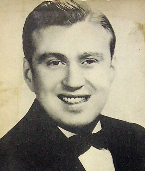
 In the glittering world of 1930s dance music, where elegance met innovation and orchestras defined the sound of a generation, few bandleaders embodied polish and professionalism quite like Richard Himber. Though often overshadowed by flashier contemporaries, Himber’s contributions to the big band era- both as a musician and an innovator- left a subtle but lasting imprint on American popular music.
Born in 1906 in Cincinnati, Ohio, Himber showed early promise as a violinist. His musical training was formal and disciplined, rooted in classical technique rather than the looser, improvisational traditions of jazz. This background would later define his approach as a bandleader: precise, controlled, and meticulously arranged. Yet Himber was no purist. As America’s musical tastes shifted in the late 1920s and early 1930s, he adapted, bringing his refined sensibility into the rapidly evolving world of dance bands.
By the early 1930s, Himber had formed his own orchestra and quickly secured engagements at some of New York’s most fashionable venues. His band became closely associated with the city’s high-society nightlife, performing at upscale hotels and clubs where sophistication was as important as swing. Among these was the storied Waldorf-Astoria Hotel, a venue that symbolized prestige and exclusivity. Himber’s orchestra fit the setting perfectly- its sound polished, its presentation immaculate.
Central to that sound was a roster of exceptional talent. Himber had an eye- and ear- for musicians who would go on to shape the direction of jazz. His band at various times included future stars such as Artie Shaw and Bunny Berigan, both of whom would later achieve fame leading their own orchestras. Himber also featured accomplished vocalists, most notably Joey Nash, whose smooth delivery complemented the band’s refined style.
In 1933, Richard Himber made his recording debut for Vocalion Records under the name “Dick Himber,” the nickname by which he was widely known among friends. Among those early recordings was his own composition, “It Isn’t Fair,” which became his signature theme and a popular hit.
After a single 1934 session for Bluebird Records, Himber moved to the more prestigious RCA Victor imprint, where he recorded steadily through 1939. During this period, he led one of the era’s most polished and refined “sweet” dance orchestras. The band featured vocalist Joey Nash from 1933 to 1935, followed by Stuart Allen, who remained with the ensemble through 1939. Himber also maintained a strong presence on radio, most notably as leader of the orchestra on Coffee Club, a weekly program broadcast over the Mutual Broadcasting System in 1937.
Unlike some of his contemporaries, Himber was not primarily a showman. His leadership style was understated, even reserved. On stage, he often performed seated, violin in hand, guiding the orchestra with quiet authority. This lack of theatricality may have limited his popular appeal in an era increasingly drawn to charismatic frontmen, but it also underscored his commitment to musical excellence over spectacle.
Himber’s recordings reflect this philosophy. His orchestra specialized in tightly arranged dance music that emphasized clarity and balance. While not as rhythmically aggressive as the swing bands that would soon dominate the airwaves, his performances possessed a subtle drive and elegance that appealed to discerning listeners. His versions of popular standards were marked by clean phrasing, tasteful ornamentation, and a disciplined ensemble sound.
Yet Himber’s most enduring contribution to music history may lie outside the bandstand. In the mid-1930s, he invented what became known as the “Himber Cord”- a clever piece of stagecraft that allowed a continuous loop of rope or string to appear cut and restored at will. Originally devised as a novelty for entertaining audiences between musical numbers, the trick gained widespread popularity among magicians and remains a staple of close-up magic today. It was an unexpected legacy for a bandleader, but one that speaks to Himber’s creativity and curiosity.
Despite his accomplishments, Himber’s career faced challenges as the musical landscape evolved. The rise of swing in the mid- to late-1930s favored bands with a stronger rhythmic emphasis and more dynamic stage presence. Leaders like Benny Goodman and Tommy Dorsey captured the public’s imagination with energetic performances and distinctive personalities. In comparison, Himber’s refined approach began to feel out of step with the times.
By the early 1940s, his prominence had diminished. Though he continued to work in music and maintain his reputation among peers, he never regained the level of visibility he had enjoyed during the early part of the decade. His story, in many ways, mirrors that of other transitional figures- artists who bridged the gap between the dance band traditions of the early 1930s and the full-fledged swing era that followed.
Richard Himber died in 1966, leaving behind a body of work that, while not as widely celebrated as some of his contemporaries, remains significant for its craftsmanship and influence. His recordings offer a window into a moment of musical transition, when orchestras were refining their sound and audiences were beginning to embrace new rhythms and styles.
Today, Himber is remembered by historians and enthusiasts as a musician’s bandleader- respected for his precision, his taste, and his ability to assemble and direct exceptional talent. In the broader narrative of American popular music, he occupies a quiet but important place: a figure who valued structure as much as swing, and whose legacy endures not through spectacle, but through the enduring quality of his work.
In an era defined by bold personalities and sweeping changes, Richard Himber chose a different path- one guided by discipline, elegance, and an unwavering commitment to the music itself.
The music of Bandleader Richard Himber can be heard on Swing Street Radio.
Craig Roberts writes the “Hot Big Band News” column for Swing Street Radio, and on occasion claims to have been Fats Waller’s piano tuner.