 In 1942, Glenn Miller was at the pinnacle of his career. His civilian orchestra was the most popular dance band in the nation, with chart-topping hits like “In the Mood,” “Moonlight Serenade,” and “Chattanooga Choo Choo.” His smooth, tightly arranged swing style had captivated millions, and his band sold more records than any other during the swing era. Yet, at the height of his fame, Miller made a decision that stunned the music world: he broke up his popular civilian band and enlisted in the United States Army.
Glenn Miller, then 38, was determined to use his musical talents to serve his country. “America means a lot to me, and what people like me have to offer should be used to win the war,” he said. Initially rejected by the Navy, Miller was eventually accepted into the Army in the fall of 1942, where he was commissioned as a captain in the Army Specialist Corps. His mission: to modernize military music and boost troop morale.
Thus began the remarkable journey of the Army Air Force Band under Miller’s direction.
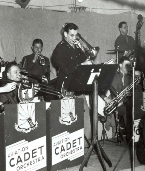
Miller immediately set about recruiting the finest musicians in the country- many of whom were top names in the civilian big band world. Among the most notable were clarinetist Peanuts Hucko, saxophonist Vince Carbone, trumpeters Zeke Zarchy and Bernie Privin, and pianist Mel Powell. He also brought in drummer and vocalist Ray McKinley, formerly of the Jimmy Dorsey and Will Bradley bands. Jerry Gray, the brilliant arranger behind many of Miller’s civilian hits, also joined the military band, helping shape its sound into a refined, energetic ensemble that blended popular swing with patriotic and classical elements.
Stationed first at Yale University and later overseas in England, Miller’s Army Air Force Band performed more than 800 times in just two years. They appeared in front of troops, on radio broadcasts, and in training films. Their live shows combined popular tunes, classical pieces, jazz standards, and military marches, all delivered with the polish and precision that had made Miller a household name.
One of the most innovative aspects of Miller’s military service was his work with the British Broadcasting Corporation (BBC). In London, he and his band recorded and broadcast hundreds of hours of music and messages aimed at Allied forces across Europe. His “I Sustain the Wings” radio program became a staple for American soldiers, reinforcing morale and connection to home.
But Miller also used his talents as part of the psychological warfare effort. Through clandestine broadcasts aimed at German listeners, the band recorded swing versions of German songs with anti-Nazi messages, using music as a powerful tool of propaganda. These recordings, produced under the supervision of the Office of War Information, were designed to undermine enemy morale and promote defection.
As the Allied push into continental Europe intensified in late 1944, Miller prepared to move his band to Paris, recently liberated from German occupation. On December 15, 1944, Miller boarded a single-engine UC-64 Norseman aircraft at RAF Twinwood Airfield (near Bedford) England, bound for France. The weather was cold and foggy, and the small plane never arrived at its destination. No wreckage was ever recovered.
Miller’s disappearance over the English Channel stunned the world and remains one of World War II’s enduring mysteries. At the time of his death, he had achieved the rank of major and had become one of the most influential musical figures of the war. His loss was deeply felt both among the troops and the public at home.
Despite the tragedy, the Army Air Force Band continued on. Sgt. Ray McKinley took over leadership, supported by arranger Jerry Gray, who kept Miller’s musical vision alive. Together, they maintained the band’s high standards and continued to perform and record until the end of the war.
The Glenn Miller Army Air Force Band left behind a rich legacy-over 500 recordings, countless broadcasts, and an innovative blueprint for using music in the service of national morale. More than just entertainment, Miller’s band had become a symbol of American unity, optimism, and resolve.
Today, Miller is remembered not only as a legendary bandleader but also as a patriot who gave up fame to serve his country in its time of greatest need. His music continues to echo through time, a swingin’ reminder of a man who chose service over stardom and whose melody marched alongside freedom.
The music of leader/composer/arranger Glenn Miller can be heard on Swing Street Radio.
Craig Roberts writes the “Hot Big Band News” column for Swing Street Radio, and on occasion claims to have been Ray Eberle’s vocal coach.